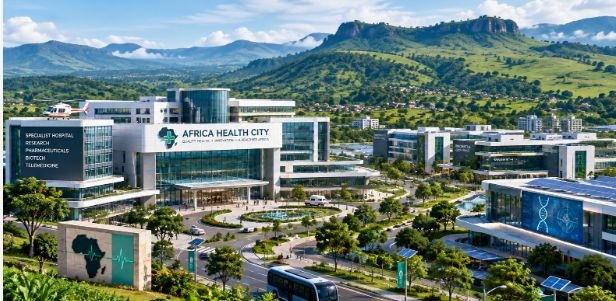
A proposed $10 billion health, wellness, research, technology and sport city is being established on Nigeria’s Mambilla Plateau in Taraba State, with its developers positioning the project as a new model for healthcare, talent development and technological innovation in Africa.
Known as Magdalene Health, Wellness, Research, Technology & Sport City, the development is being powered by Family Doctor Inc. and backed by the African Sovereign Wealth Fund (ASWF), according to a press statement shared with Etạ
The statement further said the project is being developed around the objective of making advanced healthcare and human development more accessible to Africans while creating the talent, research and technological capacity needed to sustain the ecosystem locally.
Magdalene is expected to bring several sectors together within a single development, including healthcare, wellness, research, technology, education, advanced manufacturing and sport. According to the statement, the concept goes beyond establishing another specialised medical destination and instead seeks to create an integrated health ecosystem focused on accessibility, prevention, rehabilitation, research and education.
The project comes against the backdrop of the significant challenges faced by patients across Africa seeking specialised healthcare, including shortages of medical professionals, limited access to advanced facilities and the financial burden associated with travelling abroad for treatment.
According to the statement, Magdalene is being designed to provide an environment where Africans can access healthcare, wellness and rehabilitation services without necessarily leaving the continent. Its developers also intend to bring healthcare together with sports, education, research and technology, reflecting a broader approach to physical, mental and social wellbeing.
The Mambilla Plateau forms an important part of the development’s concept. The statement describes the highland environment as having a cooler climate than many other parts of Nigeria, with the elevated terrain and natural landscape viewed as potential assets for wellness, rehabilitation, outdoor activity and longer-term recovery programmes.
Magdalene intends to undertake scientific and clinical research into how the Mambilla environment could support different forms of rehabilitation, wellness and healthcare delivery, according to the statement.
Beyond healthcare infrastructure, the development is also placing emphasis on building a local workforce. One of its first major initiatives is a programme targeting the training of 1,000 Taraba graduates for future participation in the Magdalene ecosystem and related industries.
The statement said the training will cover areas including technology, artificial intelligence, healthcare, research, engineering and advanced manufacturing. The programme is being led through the MySchool Academy and MySchool Research ecosystem, with the aim of connecting education and skills development directly to the workforce requirements of the proposed city.
Rather than relying entirely on workers recruited from outside the state, the project intends to develop a significant part of its future workforce in Taraba.
Transportation is another major element of the development, particularly given the terrain and elevation of the Mambilla Plateau. According to the statement, Magdalene’s ecosystem partner, Aerofro, is supporting the development of an African airship transportation system intended to improve movement to and from the plateau and, eventually, between communities and cities in neighbouring areas.
The statement said Aerofro has been developing an African airship platform with the long-term ambition of providing a more affordable and flexible transportation option for communities that can be difficult or expensive to reach through conventional infrastructure. It added that research and development had begun earlier, with initial prototype development already undertaken.
Education and human capital development also feature prominently in the proposed ecosystem through Africans Academy (AsA), a Pan-African educational initiative focused on preparing Africans and descendants of Africans for participation in technological and industrial development.
According to the statement, Africans Academy uses a practical, project-based education model intended to connect learning with real-world projects and emerging technologies. The institution is also committed to providing 100 per cent scholarships to qualified African students and descendants of Africans, subject to its programme requirements.
Its research and development centre is being established in Jalingo, with plans for future expansion into the wider Magdalene ecosystem.
Professor Martins Onuorah, Chair of the Governing Board of Africans Academy and Acting Vice Chancellor of the University of Kigali, described the development as an opportunity to bring healthcare, education, research, technology and human development together.
“Magdalene represents the kind of integrated, long-term thinking that Africa needs — bringing healthcare, education, research, technology and human development into one ecosystem,” Onuorah said in the statement.
He added that establishing the project in Taraba could create an opportunity to serve patients while developing the knowledge and talent needed to address African challenges with African solutions.
Research is another component of the proposed development. The statement said Magdalene has partnered with MySchool Research to support the development of research infrastructure, skills and knowledge systems required by the city.
MySchool Research is expected to support the development of a research centre within the Magdalene ecosystem while working with MySchool Academy on training and talent development. The statement said the Phase One recruitment and training pipeline will therefore be connected to the MySchool ecosystem, linking education and research with the anticipated requirements of the project.
Taken together, the proposed development represents an attempt to combine healthcare delivery with education, research, technology, transportation, sport and workforce development within one location. According to the statement , its broader ambition is to develop not only a healthcare destination but an ecosystem capable of producing the people, research and technologies needed to support its long-term growth.
The proposed Magdalene city is therefore being presented as a development centred on both healthcare and human capital, with its planners seeking to use the Mambilla Plateau as the setting for an integrated African model of health, research, education and technological development.