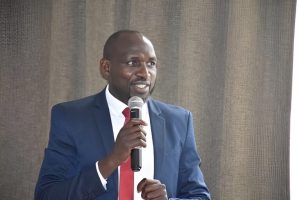
Before he became a professor with multiple degrees, Fred Ogola was a boy growing up in a crowded one-room house in Kibra, guided by a mother who believed education could change his future.
For Professor Fred Ogola, the journey from a modest home in Kibra to the world of academia began with a simple but powerful belief: education could open doors that poverty might otherwise keep shut.
In an interview on Sueo TV, the Kenyan presidential candidate reflected on his childhood, describing a family whose limited circumstances did not prevent his mother from investing in his education.
His father was a catechist, while his mother sold tomatoes and onions in an open market to support the family. Growing up among 11 siblings, Ogola said they lived in a single room in Kibra, where the entire family’s daily life unfolded within the same small space.
“It was a very simple family,” he recalled, explaining that their home was a one-room house where, as he put it, “when you’re sleeping, you can see where your mother is sleeping, your father is sleeping, your siblings, you can see the kitchen.”
Yet, within those modest surroundings, Ogola began to imagine a future beyond his immediate circumstances.
He said he was determined to pursue education and told his mother of his ambition to become a professor. Her response would become a defining part of his story.
“I told my mother I want to become a global professor,” he said.
According to Ogola, his mother promised to support him by investing in his education. She then made changes at home to create an environment where learning could become a daily priority.
“My mother changed our largest furniture in the room being a study table,” he recalled.
The family also established a study routine. Dinner was served by 6:30 p.m., after which the children would begin studying at 7 p.m. and continue until 9 p.m. before going to bed.
For a family living in a single room, the decision to make studying a central part of everyday life represented a deliberate commitment to the children’s future.
Ogola attributed much of his educational journey to the foundation his mother helped establish.
“I have never paid school fees in my life,” he said, before outlining his academic achievements: six undergraduate degrees, two master’s degrees and two PhDs. He also said he had received another PhD from Glasgow the previous month.
His account highlights a dimension of educational success that often receives less attention than academic qualifications: the sacrifices and routines that make learning possible long before achievements appear on a résumé.
His mother, who earned a living selling produce in the market, may not have had the resources to provide a spacious home or a dedicated study room. But, as Ogola described it, she made education a priority within the space and means available to her.
For him, her contribution went beyond financial support. It involved creating an atmosphere in which education was treated as an essential part of family life.
Drawing from his experience, Ogola urged Kenyan families not to overlook the importance of children’s early education while waiting for broader political and economic changes.
He warned that children who were not receiving an education today could face difficulties later in life, stressing that a strong foundation was essential to their future.
Beyond his academic journey, Ogola said he is married with three children and described the family as central to the wellbeing of society. He argued that when households struggle to afford education, healthcare and basic necessities, the consequences extend beyond individual families.
His reflections return to the circumstances in which his own ambitions first took shape: a father serving as a catechist, a mother selling tomatoes and onions, 11 siblings sharing a one-room home, and a study table that became a symbol of a family’s hopes.
For Ogola, the story of his rise is not simply about the degrees he has accumulated. It is also about a mother who responded to her son’s ambition by making room for education, even when physical space and material resources were limited.
Her story, as he tells it, is a reminder that the beginnings of an academic journey are not always found in well-equipped schools or comfortable homes. Sometimes, they begin in a crowded room, with a determined parent, a disciplined routine and a child encouraged to imagine a different future.