Traditional authority remains an important feature of governance and community life in Ghana, even as constitutional democracy and decentralised state institutions shape the exercise of public authority. This article examines how youth agency, community mobilisation and peacebuilding relate to changing expectations of traditional authority in Wli, Ghana.
Traditional authorities continue to occupy consequential positions in many African societies. Their contemporary roles cannot be understood simply as survivals from a precolonial past. In Ghana, chieftaincy has persisted within a constitutional and decentralised political order, adapting to changing relationships among customary institutions, state agencies, local communities and development actors. Research on African traditional authorities has shown that public support for chiefs is often connected to their accessibility, symbolic representation of community identity and perceived ability to mediate disputes, although such legitimacy is neither automatic nor uncontested (Logan, 2013).
The constitutional position of chieftaincy in Ghana is distinctive. Article 270 of the 1992 Constitution guarantees the institution of chieftaincy and traditional councils established by customary law and usage, while Article 277 defines a chief by reference to valid nomination, election or selection and installation in accordance with the relevant customary law and usage (Constitution of the Republic of Ghana, 1992). Constitutional protection, however, does not eliminate disagreement over succession, hierarchy, recognition or the social responsibilities of traditional leaders. Scholarship on Ghana demonstrates that chieftaincy disputes may involve not only competing claims to customary authority but also questions of state recognition, institutional status and access to governance structures (Adotey, 2019; Debrah, 2022).
Wli provides a locally significant setting in which to examine these relationships. Existing research describes Wli as comprising indigenous communities and settler communities, with traditional authority organised around a paramount stool and subordinate traditional leadership structures (Afenyo, 2018). Historical research on Ewedome also records a dispute in 1932 concerning the proposed amalgamation of Wli with Gbi rather than Akpini. Yayoh (2010) reports that chiefs, elders and people from Wli divisions petitioned the colonial administration, objected to the paramount chief’s decision, and subsequently destooled that chief and enstooled another. This historical account demonstrates that questions of political affiliation, authority and collective consent have a longer history in Wli; it does not, by itself, explain contemporary disputes or establish the views of present-day residents.
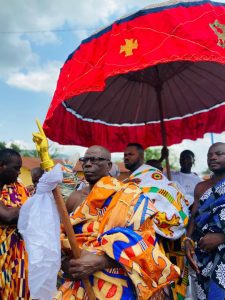
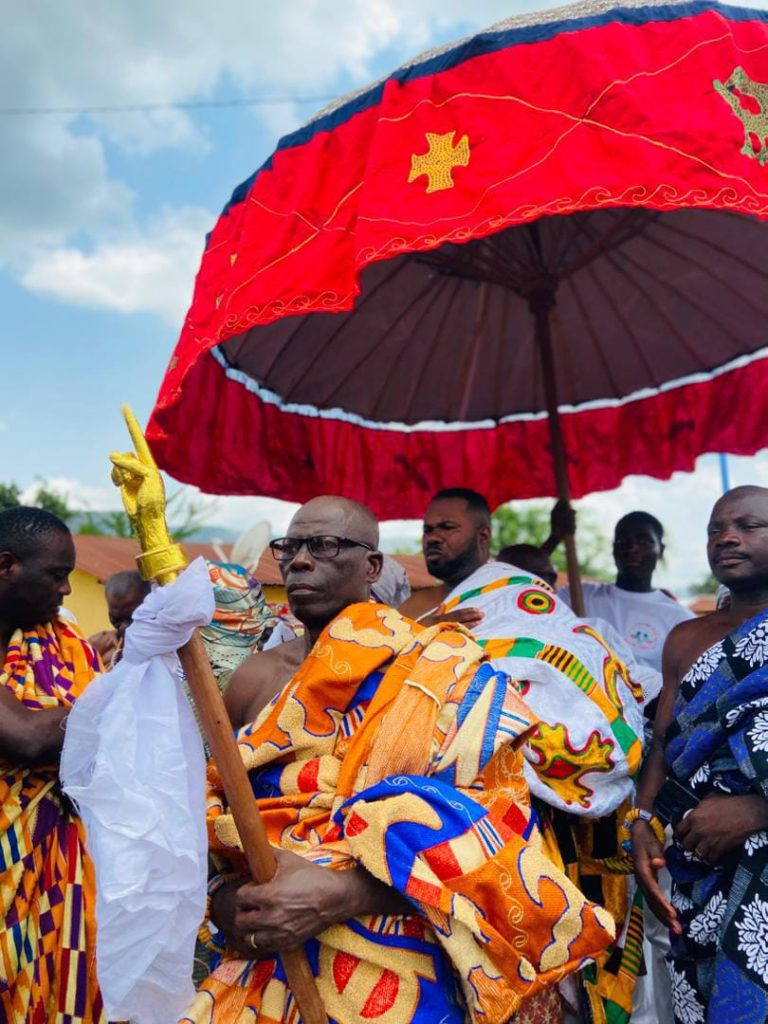
The study materials identify youth involvement in community discussions, fundraising, festival organisation, development planning and digital mobilisation. In addition to interview and communication materials, the research record includes a cost estimate and sketch for the Wli Dzigbe Nenyo Pavilion Project, as well as visual documentation of a Wli Nenyo Festival gathering at which the author was invited to preach briefly on the importance of unity. These sources make it possible to examine not only reported attitudes but also practical expressions of collective organisation. The estimate is treated as evidence of project planning, not as proof that the pavilion was built or that GH₵400,000 was collected.
Wli and Traditional Authority
Wli is located in the Hohoe area of Ghana’s Volta Region. Afenyo’s (2018) study of tourism-related livelihoods describes three indigenous communities—Afegame, Agorviefe and Todzi—and three settler communities—Dzogbega, Todome and Sorhefiakope.
The traditional governance structure is headed by a paramount chief, with divisional and subordinate chiefs, queen mothers and leaders of settler communities.
For the purposes of this article, Wli is treated as a community and governance setting in which traditional institutions, residents, youth networks, women, non-native residents and diaspora members interact.
Traditional authority in contemporary Africa operates within political environments shaped by customary institutions, constitutional government, local administration and changing community expectations. Logan (2013), drawing on comparative public-opinion evidence across African countries, finds that traditional authorities retain substantial public support, particularly in relation to conflict management, accessibility and the representation of community identity.
This evidence complicates accounts that treat chieftaincy as an institution destined to disappear under modernisation. It does not, however, imply that all chiefs enjoy equal or unconditional legitimacy.
In Ghana, the relationship between chieftaincy and the state is better understood as negotiated and sometimes contested than as a simple division between traditional and modern authority. Adotey (2019) demonstrates, through a study of a Tongu-Ewe chieftaincy dispute, that claims to paramountcy may also become claims for state recognition and access to institutions such as the Houses of Chiefs. Debrah (2022) similarly shows that the position of chiefs within decentralised local governance is complex: chiefs may be influential community actors while remaining formally outside key structures of local government.
These studies are particularly relevant to an analysis of Wli because they show that authority, recognition and development are linked but analytically distinct.
Youth Agency and Peacebuilding
Youth agency refers here to the capacity of young people to interpret their circumstances, make choices and participate in shaping collective outcomes. It moves beyond representations of youth as merely vulnerable recipients of policy interventions. In peacebuilding, this perspective directs attention to young people’s ability to convene discussions, circulate information, mobilise resources and create opportunities for cooperation. Lederach (1997) argues that sustainable peace requires attention to relationships across different levels of society and to the long-term work of rebuilding social relationships, not simply the cessation of overt disagreement.
Ghanaian research also cautions against treating youth as a uniform or inherently peace-promoting group. Gariba’s (2023) study of youth in the Alavanyo–Nkonya land conflict demonstrates that young people navigate conflict through varied social, economic and political strategies. Their agency is shaped by structural constraints and the wider conflict environment. This insight is important for Wli: youth participation should be analysed in terms of the actual activities, opportunities, constraints and relationships documented in the field materials, rather than assumed to be uniformly inclusive or successful.
The Wli Nenyo Festival and Social Cohesion
The Wli Nenyo Festival emerges in the research record as a cultural platform associated with communal identity, interaction and collective responsibility. The author also reports being invited to the festival, where he delivered a brief sermon on the importance of unity. This intervention is relevant as an example of how public cultural gatherings may provide opportunities for peacebuilding messages to be articulated alongside celebration and community interaction. The author’s participation is disclosed here because it is part of the context through which he encountered the event; it is not presented as independent proof that the festival resolved divisions or that all attendees shared the same views. The festival therefore matters not only as a cultural occasion but also as a public space in which unity and shared community concerns can be discussed.
The festival should not be assumed to have produced reconciliation simply because it brought people together. In this study, it is treated as a cultural setting in which community identity and messages about unity could be expressed. The available evidence does not establish that all attendees shared the same views or that existing disagreements were resolved.
Fundraising, Development and Collective Responsibility
The research record identifies fundraising through the Wli Nenyo Festival as part of the community’s development mobilisation. An important documentary item is the Wli Dzigbe Nenyo Pavilion Project estimate. It sets out six components: foundation (GH₵50,000); blockwork and columns (GH₵95,000); roofing (GH₵95,000); finishes (GH₵75,000); electrical and plumbing (GH₵55,000); and external works (GH₵30,000), giving a total estimated cost of GH₵400,000. The estimate is significant because it demonstrates that the development initiative had been translated into a defined project proposal with identifiable construction components and projected costs. A sketch of the proposed pavilion provides a visual representation of the intended facility . Together, the estimate and sketch move the evidence beyond a general statement that community members wanted development: they document a concrete planning effort associated with the festival and community mobilisation. They do not, by themselves, establish the amount actually raised, the source or number of contributions, whether the target was met, or whether construction commenced or was completed. Those questions require separate fundraising and implementation records.
The fundraising process is analytically important because it links civic participation to resource mobilisation. Where residents and diaspora members contribute to a shared project, the process may create opportunities for cooperation across social and geographical boundaries. It may also make questions of transparency, accountability and collective ownership more visible. The Wli evidence therefore suggests that fundraising should be understood not merely as financial activity but as a social process through which community members negotiate priorities and demonstrate commitment to a shared development agenda.
The author reports that GH₵100,010.00 was raised through the Wli Nenyo Festival.
Youth Agency as a Form of Civic Participation
The reported involvement of young people in discussions, fundraising, festival organisation, development planning and digital mobilisation suggests that youth agency in Wli can be understood as a set of practical contributions to community life. These activities create opportunities for young people to participate in public concerns without necessarily occupying formal traditional offices. This complements scholarship that treats peacebuilding as a long-term process of relationship-building and participation across social levels (Lederach, 1997).
Participation in an event or digital forum does not necessarily mean that young people determine agendas or influence final decisions. The Wli case therefore raises a further question for future research: under what conditions does youth mobilisation translate into sustained influence within customary and local governance institutions?
Editor’s Note
This article presents selected excerpts from an unpublished research paper by Rev. Francis Klu Coffie, titled Youth Agency, Peacebuilding, and the Reimagining of Traditional Authority in Wli, Ghana. The excerpts have been selected and compiled for publication in Etạ Magazine, with the author’s permission.