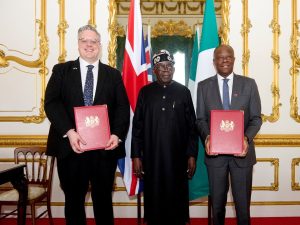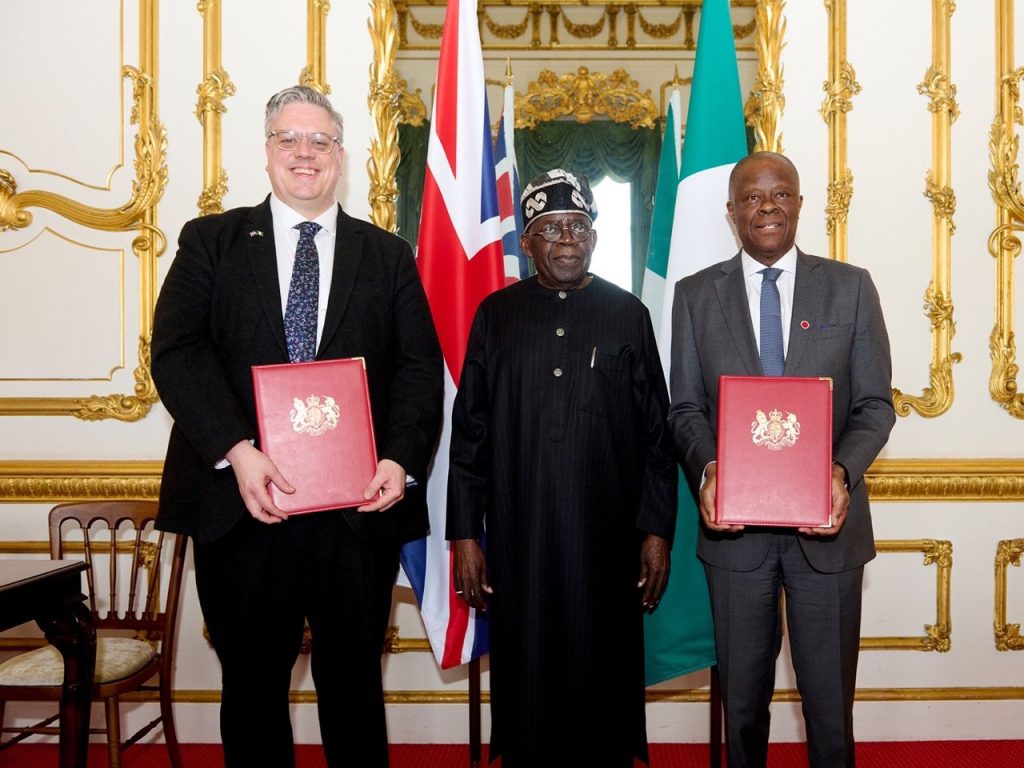
Nigeria and the United Kingdom have strengthened bilateral relations with the signing of multiple agreements covering migration, border security, business visas, and infrastructure development.
The agreements include three Memoranda of Understanding (MoUs) on Migration Partnership, a Statement of Intent on cooperation against organised immigration crime and border security, and another on expanding business visas for UK companies operating in Nigeria.
A key aspect of the partnership focuses on tackling illegal migration and streamlining deportation processes.
Under the new arrangement, Nigeria has agreed to recognise UK-issued “Letters”—identity documents used by the UK Home Office when individuals lack valid passports. This development is expected to speed up the removal of Nigerian nationals who have no legal right to remain in the UK.
UK authorities estimate that around 1,150 Nigerians are deported annually. However, the new agreement is expected to increase the frequency of removals by eliminating delays associated with obtaining emergency travel documents.
The UK also raised concerns over immigration-related fraud, including fake job sponsorships, sham marriages, and forged financial records. In response, Nigeria has pledged to strengthen its efforts to combat immigration crime.
UK Minister for Border Security and Asylum, Alex Norris, stated that the agreement reinforces efforts to maintain order at the border.
“Anyone who abuses our systems, breaks our laws or tries to cheat their way into Britain will be stopped and removed,” he said.
Recent figures indicate that nearly 3,000 Nigerians are currently in taxpayer-funded accommodation in the UK, including over 500 housed in asylum hotels. Meanwhile, asylum applications from Nigerians have risen significantly—from 1,149 in 2010 to 2,904 in 2025.
Nigeria Emphasises Balanced Migration Framework
Nigeria’s Minister of Interior, Olubunmi Tunji-Ojo, described the agreement as a step toward building a migration system that is “safe, orderly, and mutually beneficial.”
He emphasised that Nigeria remains committed to protecting its citizens while ensuring accountability for those who exploit legal migration pathways or engage in criminal activities.
Tunji-Ojo also highlighted the importance of easing legitimate travel and business processes, particularly through the expansion of business visas.
“Visa policy should serve as a catalyst for socio-economic development,” he said, noting that reducing barriers is key to achieving Nigeria’s long-term economic goals.
UK Home Secretary Shabana Mahmood described Nigeria as a leading partner in bilateral cooperation, commending the depth of the agreement.
£746 Million Ports Deal to Boost Trade and Jobs
In addition to migration agreements, both countries sealed a £746 million financing deal to modernise Nigeria’s port infrastructure.
The investment will support the rehabilitation of two major facilities in Lagos—the Lagos Port Complex (Apapa) and Tin Can Island Port.
The project, financed through UK Export Finance (UKEF) and arranged by Citibank London, is expected to:
-
Improve port efficiency and reduce cargo delays
-
Lower logistics and operational costs
-
Enhance transparency through digitalisation
-
Strengthen Nigeria’s position as a regional maritime hub
At least £236 million of the contract value will benefit British companies, with British Steel supplying 120,000 tonnes of steel in a deal valued at £70 million.
Nigeria’s Minister of Marine and Blue Economy, Adegboyega Oyetola, described the initiative as transformative for the country’s economy.
“Modern infrastructure and automated processes will significantly improve efficiency, reduce bottlenecks, and enhance Nigeria’s competitiveness in global trade,” he said.
Alongside the ports deal, both countries signed an additional framework agreement outlining future collaboration opportunities across infrastructure and trade.
The agreements signal a deepening relationship between Nigeria and the UK, combining migration management with economic cooperation.
With a focus on security, trade, and development, both nations appear committed to building a partnership that delivers mutual benefits while addressing shared challenges.