Before women in Nigeria had equal access to many public spaces, before female political participation became widely accepted, and before the struggle for women’s rights gained the visibility it has today, Chief Funmilayo Ransome-Kuti was already challenging convention.
Born on 25 October 1900, Ransome-Kuti became an educator, nationalist, political campaigner, women’s rights activist and traditional title holder. She would go on to become one of the most influential African women of the 20th century.
But among the many remarkable chapters of her life is one that captures her pioneering spirit particularly well: **her place in Nigeria’s early motoring history.
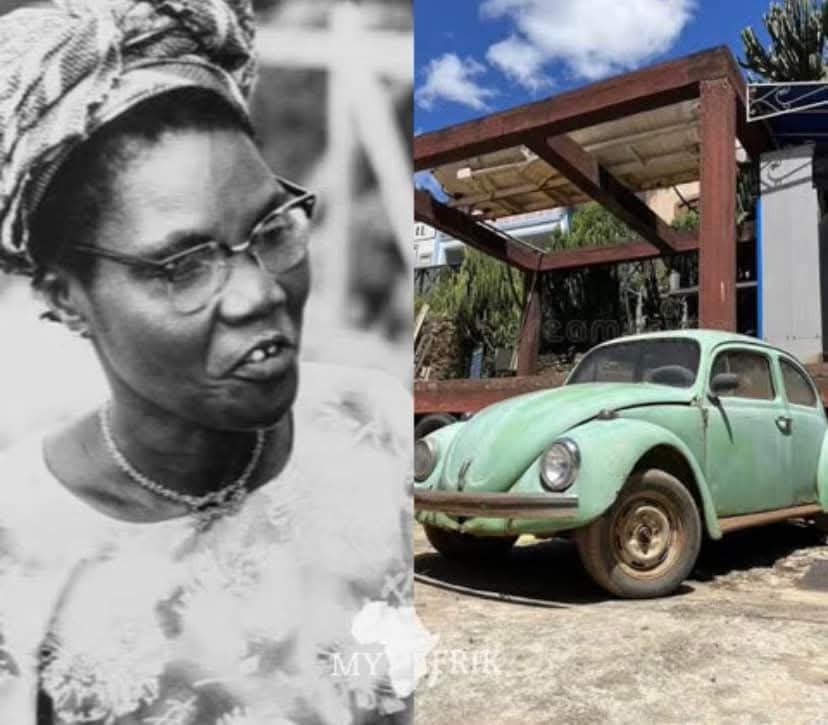
Historical accounts widely credit Funmilayo Ransome-Kuti as **the first woman to drive a car in Nigeria.
In the mid-1930s, she and her husband, Reverend Israel Oludotun Ransome-Kuti, acquired a second-hand car from England. By 1936 Funmilayo was known in ,Abeokuta as a woman who drove.
At a time when automobiles were still relatively uncommon and driving was largely considered a man’s preserve, her decision to take the wheel was more than a novelty. It reflected the character that would define much of her life: **a refusal to accept restrictions simply because society considered them normal.
The car became another symbol of her independence.
Yet her significance went far beyond the driver’s seat.
Funmilayo Ransome-Kuti began her career as an educator, but her growing awareness of social and political inequalities drew her into activism.
She became a leading organiser of the **Abeokuta Women’s Union (AWU)**, bringing thousands of women together to challenge policies they considered oppressive, including unfair taxation and the exclusion of women from political decision-making.
Under her leadership, women transformed from largely overlooked subjects of colonial administration into a formidable political constituency.
Her activism demonstrated something that would become central to Nigeria’s nationalist movement: **women were not merely spectators in the struggle for self-government. They were organisers, protesters and political actors.
Ransome-Kuti’s activism increasingly placed her in opposition to colonial rule.
She travelled internationally and participated in political discussions about Nigeria’s future. Her contacts with socialist countries during the Cold War era also attracted the attention and suspicion of Western governments and colonial authorities.
She nevertheless continued to campaign for African political and social rights.
Her influence eventually extended well beyond Abeokuta. She became an internationally recognised African woman whose political activities connected the struggle for Nigerian independence with broader movements for women’s rights, anti-colonialism and social justice.
In 1970, she received the Lenin Peace Prize recognising her international political and anti-colonial activities.
The Ransome-Kuti family would become one of Nigeria’s most remarkable political and cultural families.
Her husband, Reverend Israel Oludotun Ransome-Kuti, was an influential educator and clergyman. Their children included Olikoye Ransome-Kuti, who became a prominent physician and public-health advocate, and Fela Anikulapo-Kuti, who would become Nigeria’s legendary Afrobeat musician and outspoken political critic.
Through Fela, Funmilayo’s legacy became intertwined with another generation’s resistance to military authoritarianisim
In February 1978 , soldiers raided Kalakuta Republic, the communal compound founded by Fela Anikulapo-Kuti and a centre of his political and musical activism.
During the attack, Funmilayo Ransome-Kuti was thrown from a second-floor window. She suffered severe injuries and fell into a coma.
She died in Lagos on 13 April 1978 aged 77.
Her death devastated the Ransome-Kuti family and became a defining episode in the history of Fela’s confrontation with Nigeria’s military establishment
Following his mother’s death, Fela took her coffin to Dodan Barracks, then the seat of Nigeria’s military government.
It was an extraordinary act of political protest.
The image of a son delivering his mother’s coffin to the nation’s centre of military power became one of the most powerful political statements of Fela’s career.
He later immortalised the episode in the song “Coffin for Head of State.”
The coffin became a symbol—not simply of personal grief, but of Fela’s accusation that the state had failed to protect an elderly woman who had herself devoted decades to fighting for Nigeria’s people.
It is tempting to remember Funmilayo Ransome-Kuti primarily for the distinction of being the first Nigerian woman credited with driving a car.
But the car was only one expression of her pioneering character.
She drove when women were expected to remain passengers.
She organised when women were expected to remain silent.
She challenged colonial authorities when resistance carried serious consequences.
She demanded political representation when women were largely excluded from formal political power.
And she continued campaigning on an international stage when Nigeria’s political future was still uncertain.
Funmilayo Ransome-Kuti did not simply break one barrier. She spent her life challenging barriers.
Today, Chief Funmilayo Ransome-Kuti stands as an enduring figure in Nigerian history—a pioneer of women’s political mobilisation, a nationalist, educator and activist whose influence reached across generations.
Her story reminds us that pioneering achievements are not always isolated moments. Sometimes, they are part of a lifetime spent refusing to accept the boundaries imposed by one’s era.
She was a woman behind the wheel—but she was also a woman determined to help steer Nigeria’s future.