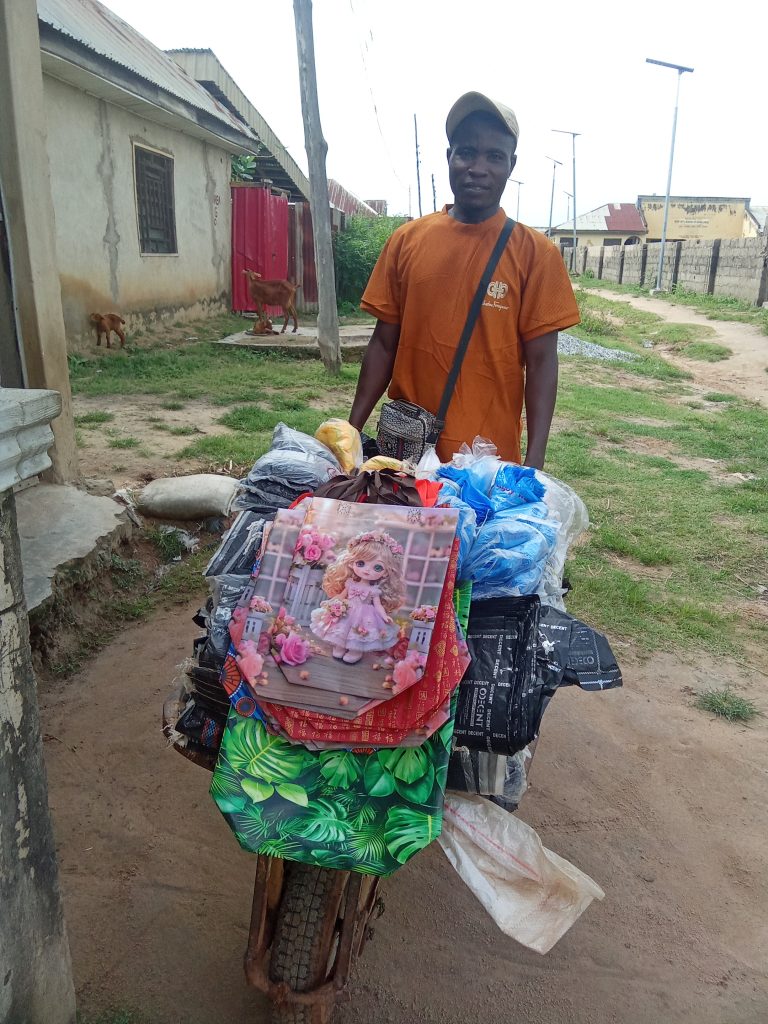
In Abuja, Nigeria, Mohammed ,a young trader from Sokoto aged 35, is building a livelihood one sale at a time.
Sometimes, all you need to do is stop, ask questions and listen.
That was how I met Mohammed, a man from Sokoto who has been living in Abuja for some months. His business is straightforward: he sells polythene bags of different types and sizes from a wheelbarrow.
Curious about his trade, I asked him how much someone would need to start a similar business.
His answer was about ₦200,000 or more.
I also wanted to know whether the business was profitable. He said it was.
Then Mohammed made a statement that stayed with me. He asked me to look at him and consider how he appeared.
I took another look. He was neat and well-presented, standing beside the wheelbarrow that served as his place of business.
He was happy with what he was doing, he explained, because the business enabled him to feed himself and meet his basic needs.
There was something meaningful about that response. Mohammed was not talking about becoming a millionaire or building a business empire. He was talking about being able to take care of himself through his work.
For many people, success is measured by the size of a business, the number of employees, the office one occupies or the lifestyle one can afford. But for someone working to establish himself, the ability to earn an income, provide for daily needs and live with a measure of independence can be a significant achievement.
Mohammed’s wheelbarrow may not resemble the conventional image of a business, but it is his means of earning a living. Behind it are the everyday realities of trade: finding customers, selling goods and working towards financial independence.
His experience also raises a practical question for anyone considering a small business: what can you start with the money available to you, and can it meet your needs?
Mohammed believes his trade is worthwhile. However, anyone interested in following a similar path would need to investigate the cost of stock, transportation, storage, customer demand and other expenses before deciding whether the business is right for them.
For now, Mohammed is content that his work provides for his basic needs.
His story is a reminder that enterprise does not always begin in a shop, an office or a beautifully furnished workspace. Sometimes, it begins with a wheelbarrow, goods to sell and the determination to earn a living.