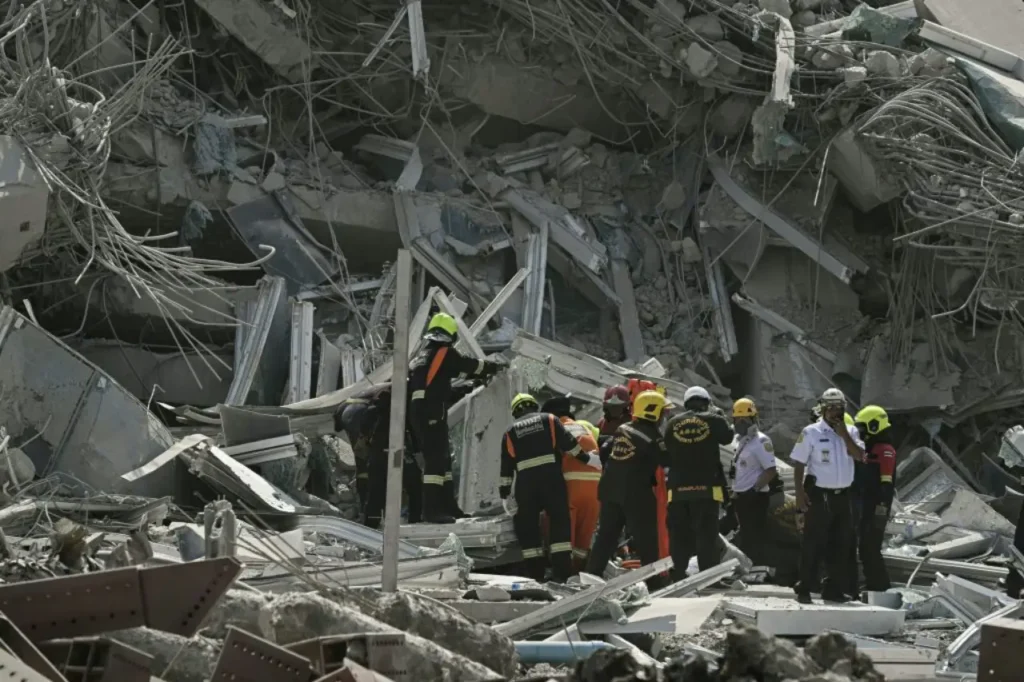
A powerful 7.7-magnitude earthquake struck Southeast Asia on Friday, leaving a trail of destruction and despair across Myanmar and Thailand. The seismic disaster, with its epicenter near Mandalay, Myanmar’s second-largest city, has triggered a large-scale humanitarian crisis as emergency response teams scramble to rescue survivors and provide aid to affected communities.
Thousands are feared dead, with confirmed casualties already surpassing 144 in Myanmar and 10 in Thailand. The number is expected to rise as rescue efforts continue. Officials in Myanmar have declared a state of emergency in Naypyidaw, with at least 732 reported injuries across the country.
Myanmar’s Senior General Min Aung Hlaing described the scene as “catastrophic,” highlighting the collapse of buildings, including religious sites, homes, and businesses. In the town of Taungoo, a mosque partially collapsed, claiming the lives of at least three worshippers, while another hotel crumbled in Aung Ban, killing two and injuring 20 others.
Meanwhile, in Thailand, the disaster struck the bustling capital of Bangkok, where an under-construction skyscraper collapsed, leaving at least eight dead and dozens trapped beneath the wreckage. Defense Minister Phumtham Wechayachai reported that over 80 people remain unaccounted for, sparking an urgent and complex rescue operation.
The earthquake’s impact stretched across hundreds of miles, sending shockwaves that rattled buildings and triggered mass panic. In Bangkok, scenes of chaos unfolded as terrified residents and tourists fled hotels, some still dressed in bathrobes and swimwear, after witnessing water cascading from an elevated pool at a luxury resort.
Infrastructure damage is extensive, with roads cracked, communication lines disrupted, and emergency services overwhelmed. The United States Geological Survey (USGS) has classified the disaster as a “red alert” situation, estimating a potential death toll between 1,000 and 10,000.
In response to the crisis, global humanitarian organizations and neighboring nations are preparing to dispatch aid, medical supplies, and rescue teams. The United Nations and Red Cross have pledged emergency relief efforts, while governments worldwide have expressed solidarity with the victims.
Myanmar and Thailand, both prone to seismic activity, have struggled in the past with disaster preparedness. This earthquake underscores the need for enhanced early warning systems and improved building regulations to mitigate future devastation.
What’s Next?
As rescue teams work tirelessly against time, the focus remains on saving lives, reuniting families, and assessing the full extent of the destruction. With thousands displaced and communities left in ruins, the road to recovery will be long and demanding.