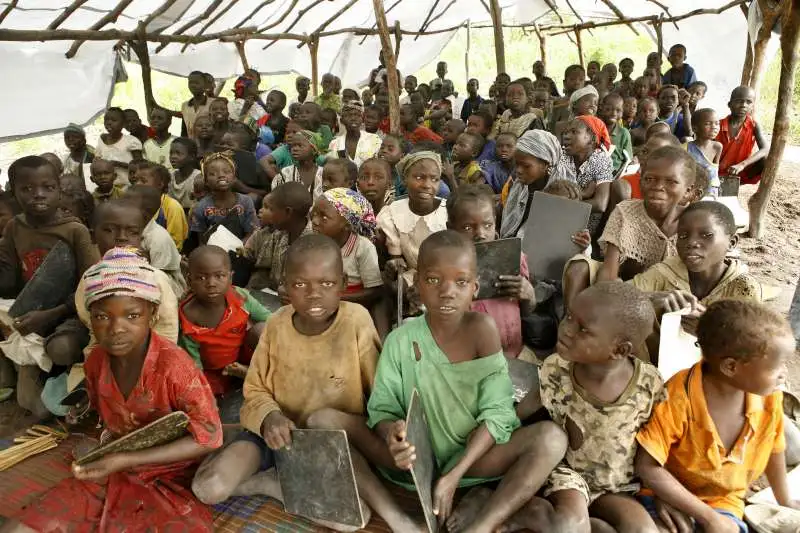
NEW YORK, September 3, 2025 – The United Nations Children’s Fund (UNICEF) has sounded the alarm over a looming global education crisis as steep funding cuts threaten to push an additional 6 million children out of school by the end of 2026, with about one-third of them in humanitarian settings.
A new UNICEF analysis projects a US$3.2 billion decline in Official Development Assistance (ODA) for education – a 24 per cent drop compared to 2023. Nearly 80 per cent of these cuts are linked to just three donor governments. If the cuts go ahead, the number of out-of-school children worldwide will rise from 272 million to 278 million – equivalent to emptying every primary school in Germany and Italy combined.
“Every dollar cut from education is not just a budgetary decision, it’s a child’s future hanging in the balance,” said UNICEF Executive Director Catherine Russell. “Education, especially in emergency settings, often serves as a lifeline, connecting children to essential services like health, protection, and nutrition.”
Regions at Greatest Risk
The impact will be felt unevenly across the world:
West and Central Africa could see 1.9 million more children out of school.
Middle East and North Africa may record an additional 1.4 million children missing education.
Côte d’Ivoire and Mali are among the most vulnerable, with enrolment rates at risk of falling by 4 per cent – affecting 340,000 and 180,000 students respectively.
Globally, primary education is expected to be hit hardest, with funding projected to fall by one-third, potentially costing affected children an estimated US$164 billion in lifetime earnings.
Humanitarian Settings at Breaking Point
For children in conflict zones and refugee camps, education is more than learning – it is a lifeline. UNICEF warns that cuts could see the closure of learning centres for 350,000 Rohingya refugee children, leaving them exposed to exploitation, child labour, and trafficking.
School feeding programmes, often a child’s only nutritious meal of the day, may see their budgets reduced by half, while investments in girls’ education also face sharp declines.
A Call to Action
UNICEF is urging governments and partners to:
Ensure at least 50 per cent of education aid goes to the least developed countries.
Safeguard humanitarian education funding and treat it as a lifesaving intervention.
Prioritise foundational learning in early childhood and primary education.
Reform global financing systems to be more efficient under the UN80 Initiative.
Expand innovative financing while protecting core education budgets.
“Investing in children’s education is one of the best investments in the future – for everyone,” Russell stressed. “Countries do better when their children are educated and healthy, and it contributes to a more stable and prosperous world.”