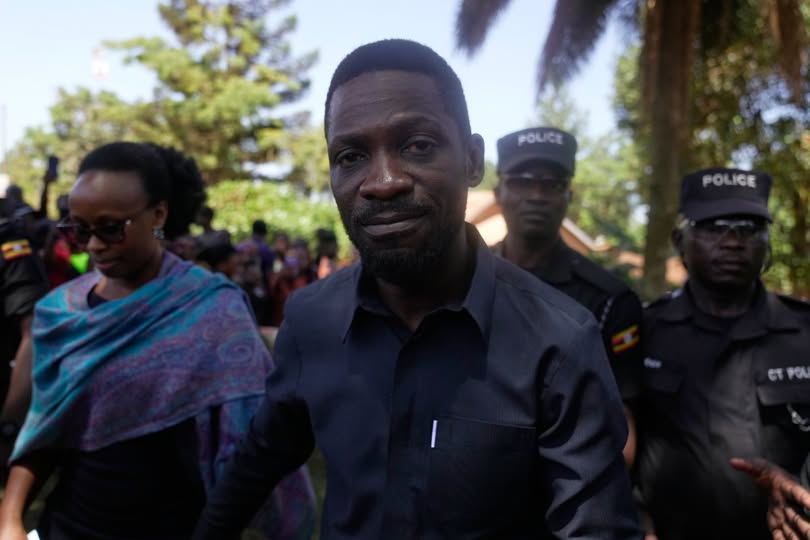
In moments of political tension, states often reveal their true character not through official speeches, but through actions carried out quietly and forcefully. In Uganda, the military raid on opposition leader Bobi Wine’s home has become one such moment, exposing the fragile boundaries between political power, military authority, and democratic space in a country governed by the same leader for nearly four decades.
When Uganda’s Information Minister, Chris Baryomunsi, publicly condemned the raid and stated that Bobi Wine had committed no crime and was free to return to his home, the declaration appeared to reaffirm civilian authority. Yet the absence of clear accountability raises deeper questions about what such condemnation truly means in a political system where power is tightly centralised.
Bobi Wine, a pop star turned politician, went into hiding shortly before he was announced runner-up in Uganda’s January presidential election. His disappearance was not preceded by a court order or formal charges, but unfolded amid heightened military presence, online threats, and political uncertainty. Weeks later, Wine reported that soldiers invaded his home and assaulted his wife, forcing her to seek medical treatment. Whether or not these claims lead to prosecution, the raid itself sent a powerful message about the reach of the state and the risks associated with dissent.
At the centre of the controversy is Uganda’s military chief, Muhoozi Kainerugaba, who is also President Yoweri Museveni’s son. His repeated social media posts, including threats against opposition figures and declarations of military action, have blurred the line between personal expression and institutional authority. Although government officials have attempted to dismiss these statements as informal and non-representative of state policy, their impact is difficult to separate from the power attached to his office.
This ambiguity has created a system of plausible deniability in which military power is projected publicly while responsibility remains diffuse. Civilian officials offer reassurances, the military speaks with confidence, and citizens are left navigating uncertainty. In such an environment, the law appears secondary to force, and accountability becomes optional rather than expected.
Uganda’s elections increasingly end without democratic closure. Opposition candidates challenge results, security forces tighten their grip, and investigations are promised but rarely result in transparent outcomes. In Bobi Wine’s case, the military has indicated it is searching for him, yet no specific crime has been identified. This framing transforms political opposition into a security issue, reinforcing a narrative in which dissent is treated as destabilisation rather than democratic participation.
Beyond Uganda, the episode reflects a wider continental pattern in which long-ruling governments rely on military structures to manage political competition. As civic space narrows, elections continue to take place, but public confidence in democratic institutions erodes. Uganda’s significant role in regional security operations, including its military presence in Somalia, further complicates the balance between authority at home and legitimacy abroad.
The raid on Bobi Wine’s home is therefore not merely an isolated incident of alleged misconduct. It is a reflection of a political system where power is concentrated, dissent is securitised, and accountability remains uncertain. Ministerial condemnation may indicate internal unease, but history suggests that without visible consequences, such statements offer little reassurance.
For Uganda’s democracy, the core issue is no longer whether elections are held, but whether political opposition can exist without fear, intimidation, or military intervention.