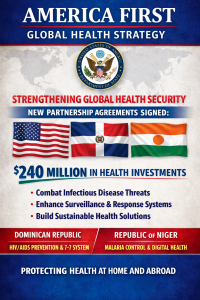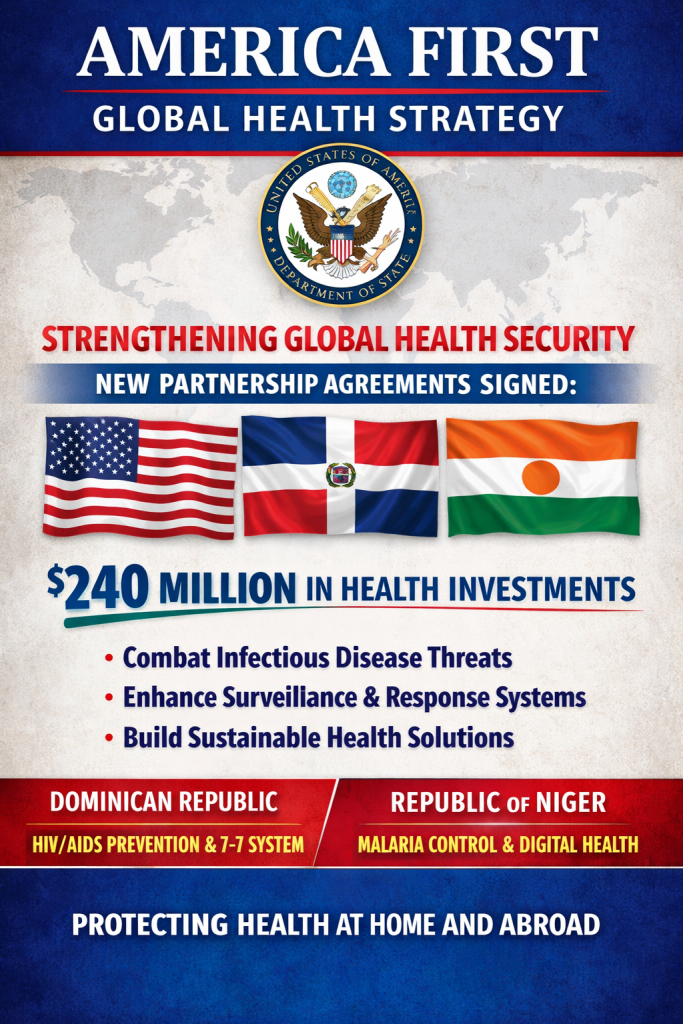
The United States has signed new bilateral health cooperation agreements with the Dominican Republic and the Republic of Niger, committing more than $240 million in combined U.S. funding and partner-country co-investments to strengthen infectious disease prevention and response systems.
Announced in a press statement by the U.S. Department of State, the five-year Memoranda of Understanding (MOUs) fall under the Trump Administration’s America First Global Health Strategy, a framework designed to reinforce global health security while shifting long-term ownership to partner nations.
In the Dominican Republic, the United States intends to provide up to $46.7 million over five years to support efforts to combat HIV/AIDS and other health threats. The Dominican government has committed to increasing its domestic health spending by $14.1 million within the same period. Together, the agreement represents a $60.8 million health security partnership.
A key component of the Dominican Republic MOU is the establishment of a “7-1-7” disease surveillance system — designed to detect infectious disease outbreaks within seven days, notify U.S. authorities within one day, and initiate response measures within seven days. More than $6 million is allocated to strengthen global health security systems, laboratory capacity, and frontline response mechanisms. By 2028, the Dominican Republic is expected to assume full responsibility for health commodities, healthcare workers, and laboratory systems, with U.S. assistance transitioning toward surveillance support and innovation.
In Niger, the United States signed a larger five-year agreement valued at $179.3 million. Of this amount, up to $107.4 million is expected from U.S. funding, while the Government of Niger will increase its domestic health expenditures by $71.9 million.
The Niger MOU focuses on combating malaria, strengthening maternal and child health systems, and expanding disease surveillance and outbreak response capabilities. It includes $5 million dedicated to global health security funding and the development of a comprehensive digital health ecosystem. The initiative will integrate six national health information systems, including electronic medical records, laboratory management, pharmacy tracking, outbreak surveillance, commodity inventory control, and a national health data warehouse.
U.S. officials emphasize that these agreements not only strengthen health systems abroad but also protect Americans by reducing the risk of cross-border infectious disease transmission. By investing in early detection and rapid containment systems, the strategy seeks to prevent outbreaks from escalating into global crises.
Since the launch of the America First Global Health Strategy, nearly $20 billion in health funding commitments have been secured through bilateral MOUs — including $12.4 billion in U.S. assistance and $7.6 billion in co-investment from recipient countries. As of February 27, 21 countries across Africa, Latin America, and the Caribbean have signed similar agreements, including Botswana, Kenya, Nigeria, Rwanda, Uganda, and others.
The new MOUs with Niger and the Dominican Republic reflect a broader shift toward shared responsibility in global health partnerships — combining U.S. funding, local investment, digital transformation, and surveillance innovation to reinforce global health security in an interconnected world.