PART ONE — Foundations of the Northernization Policy in Kaduna
Colonial Legacy, Regional Politics, and the Making of a Divided Structure
By Paul Nkom Yashim
Introduction
Before independence, the colonial administration placed little priority on developing Northern Nigeria. But with self-rule, the region’s indigenous leadership — particularly under Sir Ahmadu Bello, the Sardauna of Sokoto — began an aggressive push for industrial expansion, commercial growth, and broad-based economic transformation.
This shift ushered in a period of import-substitution industrialization, designed to harness the North’s human and natural resources while closing the development gap between the North and the South. Key regional institutions were created to support this mission:
-
Northern Nigeria Development Corporation (NNDC)
-
Northern Nigeria Investments Limited (NNIL)
-
Nigerian Industrial Development Bank (NIDB)
-
Northern Regional Development Board (NRDB)
-
Northern Nigerian Marketing Board (NNMB)
-
Commercial Development Corporation (CDC)
These agencies became the engines for strategic investments and the push toward regional self-sufficiency.
Building Capacity in the Sardauna Era
The Sardauna government understood that meaningful industrialization could not occur without a skilled workforce. As a result, the region embarked on one of the most ambitious human-capital development programs in Nigeria’s early post-colonial history.
Key initiatives included:
-
Sponsoring Northerners to technical and vocational schools
-
Establishing teacher-training colleges and diploma institutions
-
Funding university education at home and abroad
-
Creating Ahmadu Bello University (A.B.U.) — the first major university in the region
-
Setting up the Administrative Institute, Zaria
These programs produced graduates who filled strategic positions in the Regional Civil Service, Federal Service, and the rapidly expanding private sector — especially the textile industry.
Why Kaduna Became the Industrial Heart of the North
Kaduna soon emerged as a focal point of industrialization. The region’s leadership strategically selected the city to complement Kano, the traditional commercial capital.
Reasons for Kaduna’s rise included:
-
Its emerging manufacturing potential
-
Strategic location along major rail and road networks
-
The region’s desire to create a second industrial hub
This transformed Kaduna from a garrison and administrative centre into one of the most important commercial cities in the North.
Rise of Political, Religious, and Cultural Movements
The post-colonial environment saw the emergence of several political, religious, and union-based groups. In the North, two key political formations shaped the ideological landscape:
-
Northern People’s Congress (NPC) – conservative and establishment-leaning
-
Northern Elements Progressive Union (NEPU) – radical and populist
Kaduna, with its diverse population and strategic importance, became a melting pot where these identities clashed and interacted, influencing political life across the region.
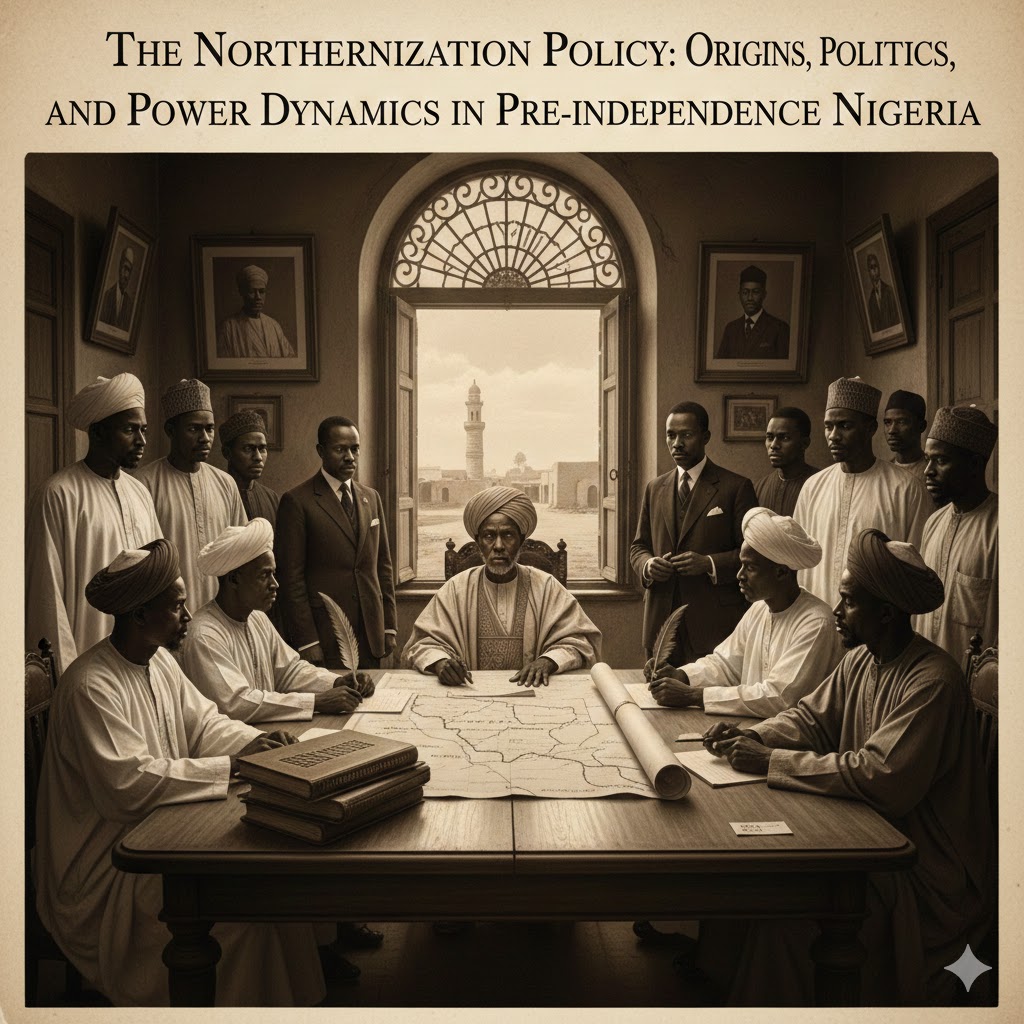
Origins of the Northernization Policy
The Northernization Policy did not begin with independence — its roots stretched back to the colonial era, when the North was governed separately from the South. British administrators discouraged missionary and southern influences in order to maintain stability under indirect rule.
This produced long-term consequences:
-
Regional isolation
-
Mistrust between Northerners and Southerners
-
Uneven development and education levels
By the 1950s, these historical dynamics shaped northern political thinking, especially regarding who should occupy administrative positions in the region.
Political Developments Before 1954
As constitutional reforms gradually gave Northerners more administrative responsibility, political parties emerged along regional lines:
-
NPC (North) – led by Sir Ahmadu Bello
-
AG (West) – led by Obafemi Awolowo
-
NCNC (East) – led by Nnamdi Azikiwe
The political landscape grew more divisive during the 1953 parliamentary debates, when Anthony Enahoro’s motion for self-government triggered intense disagreement. The Sardauna argued that the North was unprepared due to its late exposure to Western education — a position that led to Southern mockery and Northern resentment.
This moment deepened the regional rift.
Why the Northernization Policy Was Implemented
By 1955, Ahmadu Bello expressed concern over the dominance of Southerners in key administrative structures in the North:
-
Regional Public Service
-
Local Government Councils
-
The Kaduna Capital Territory Council
Northerners were underrepresented in their own region’s institutions. This led to the formal adoption of the Northernization Policy in 1954, and its full implementation by 1958.
The policy sought to ensure that Northerners filled available positions in the regional civil service and public institutions.
Impact and Immediate Consequences
The implementation came with significant changes:
-
Over 100 non-northern clerks dismissed
-
600 non-northern daily-paid workers removed
-
By August 1958, 2,148 Southerners were laid off from Regional Service
-
Only 24 Southerners remained in senior positions
These actions reshaped inter-group relations, creating tensions, stereotypes, and deep ethnic mistrust — particularly in Kaduna, the administrative heart of the region.
The Aftermath: Instability and Military Intervention
Ethnic resentment, political rivalry, and fears of domination contributed to the instability that followed:
-
The January 1966 coup
-
The July 1966 counter-coup
-
Worsening ethnic relations
-
The Nigerian Civil War
These events fundamentally altered civil–military relations and left a lasting imprint on Kaduna’s political atmosphere.
Kaduna’s Geographic and Administrative Background (From 1912)
In 1912, Lord Lugard selected Kaduna as the military and administrative capital of Northern Nigeria due to:
-
River Kaduna’s reliable water supply
-
A central position among the emirates
-
Proximity to major railway lines:
-
Lagos–Kano (1911)
-
Port Harcourt–Kaduna extension (1927)
-
-
Distance from political turbulence in Zaria
These factors made Kaduna ideal for colonial governance.
Kaduna Today: An Industrial and Administrative Hub
Modern Kaduna remains one of the most important cities in Northern Nigeria. It is home to:
-
Textile factories and manufacturing hubs
-
Commercial centres and business districts
-
Leading banks and insurance companies
-
Federal and state ministries
-
Military and defence institutions
The city is divided by the River Kaduna into:
-
Kaduna North LGA
-
Kaduna South LGA
Ethnic and Cultural Diversity
Kaduna’s population reflects decades of migration, industrialization, and administrative importance. It hosts more than 200 ethnic groups, including:
Gbagyi, Hausa, Fulani, Kanuri, Nupe, Atyap, Bajju, Ikulu, Jaba, Yoruba, Igbo, Edo, Ibibio, Ijaw, Tiv, Idoma, Angas, Birom — and many others.
This diversity makes Kaduna one of Nigeria’s most cosmopolitan northern cities.
Economy of Kaduna
Historically, Kaduna was not designed as a commercial centre. Early colonial investment focused on administration and resource extraction rather than manufacturing. It lagged behind Kano, Zaria, and Jos in trade and commerce.
But the Northernization era changed this narrative, transforming Kaduna into a strategic industrial hub — especially in textiles and manufacturing.
This article is adapted from the academic thesis of Paul Nkom Yashim on the Northernization Policy (1958–1966), and is published with the author’s permission.