Art has the power to challenge assumptions and create opportunities where few exist. For Deborah Maikarfi, sculpture is not only about shaping materials but also about shaping perceptions and livelihoods.
Sculpture is often seen as a field dominated by men, but artists like Deborah Maikarfi are steadily reshaping that perception through creativity, teaching, and entrepreneurship.
Deborah Maikarfi is a professional sculptor and lecturer in the Department of Fine and Applied Arts at Kaduna State College of Education, Gidan Waya. She studied Fine Arts at Ahmadu Bello University, Zaria, where she earned both her bachelor’s and MFA degrees.
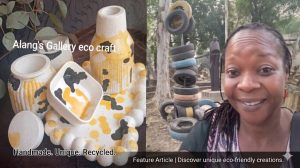
She is also the founder and CEO of Alang’s Gallery, an online platform on Facebook where she showcases and sells her sculptures and crafts, sharing her passion for art with the world. A proud wife and mother of one son, Alang, she named her gallery after him.
In this interview with Etạ , she shares her journey into sculpture, the challenges of being a female sculptor in Northern Nigeria, and how art can empower communities.
What inspired you to become a sculptor, and how has your background influenced your artistic vision?
My journey into sculpture was inspired by a combination of natural talent, encouragement from mentors, and my cultural background. From my primary school years, my teachers and classmates noticed my ability to create designs and craft works, and I often excelled in Creative Arts. I was later told that my grandmother was a potter, which made me realize that artistic creativity may run in my family.
Sculpture particularly fascinated me because of its three-dimensional nature. Unlike painting, which is flat, sculpture involves creating solid forms that occupy space, making it more challenging and engaging for me. As a woman in a field often dominated by men, the admiration and curiosity I received when people saw me sculpting further motivated me.
With encouragement from my secondary school Fine Arts teacher, Mr. Daniel Azebre, I pursued Fine Arts academically and eventually studied it at Ahmadu Bello University, Zaria.
What challenges have you faced as a sculptor in Nigeria, and how have you overcome them?
One of the major challenges I face is being a female sculptor from Northern Nigeria, particularly Southern Kaduna. Sculpture is often seen as a field dominated by men, so convincing people that I could successfully produce sculptural works has been difficult.
Another challenge is the misconception, especially among some religious groups, that sculptures are associated with negative spiritual practices.
To overcome this, I focus on creating awareness about what sculpture truly represents. Through my social media platform, Alangs Gallery, I showcase sculptural crafts such as resin epoxy jewelry and gypsum eco decorative items for homes and offices. By doing this, I help people realize that many everyday decorative and fashion items actually originate from sculptural skills.
How do you hope your sculptures influence people, communities, or perceptions of Nigerian art? What are your future artistic goals?
As a lecturer teaching sculpture in the Department of Fine and Applied Arts at Kaduna State College of Education, Gidan Waya, one of the main ways I influence people is by passing on my knowledge and practical skills to my students.
Beyond the classroom, I also participate in community training programs organized by NGOs, churches, and other groups, where I teach women and youths sculptural skills that can help them generate income and improve their livelihoods.
My goal is to show that sculpture is not only a form of artistic expression but also a practical skill that can empower individuals and communities.
Looking ahead, one of my major artistic goals is to explore the digital space, particularly digital sculpture. As we continue to move deeper into a digital era, I am interested in integrating technology into my artistic practice and expanding the possibilities of sculpture through digital platforms.
Can you walk us through your creative process from idea to finished sculpture?
The creative process in sculpture usually begins with an idea, which I first develop through sketches on paper. These sketches help me visualize how the design can be transformed from a two-dimensional drawing into a three-dimensional form.
Sculpture can be created using different materials such as clay, wood, metal, cement, or plaster of Paris (POP). The choice of material often depends on the nature of the work I want to produce.
As a sculptor, it is important to understand the character and behavior of the chosen material before working with it.
With this knowledge, I carefully manipulate the material to bring the sketched idea into form. The final stage involves refining the piece and giving it a proper finish so that the sculpture is well presented and communicates the intended artistic expression.
.