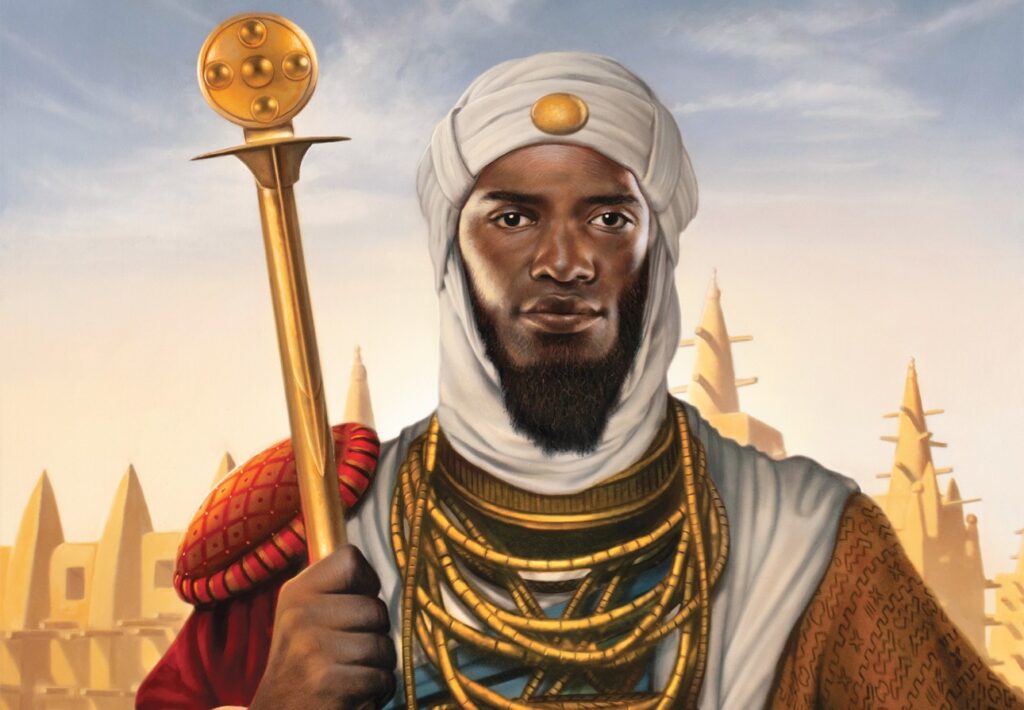
When we talk about the wealthiest individuals ever, names like Jeff Bezos and Elon Musk often dominate the conversation. Yet, centuries before their time, an African emperor ruled with a fortune so vast that historians still struggle to calculate its true worth. His name was Mansa Musa, and his story is one of power, legacy, and cultural pride.
Who Was Mansa Musa?
Born around 1280, Mansa Musa became the ninth emperor of the Mali Empire, a West African kingdom famed for its wealth, trade, and scholarship. His title “Mansa” means “king of kings,” and Musa more than lived up to it.
Taking the throne in 1312, Musa inherited an empire already thriving thanks to its control of lucrative trade routes. But it was under his leadership that Mali reached its golden age, stretching across modern-day Mali, Guinea, Senegal, Mauritania, and beyond.
Though early griots focused on heroic figures like Sunjata, Arab scholars like Al-Umari and Ibn Khaldun helped preserve Musa’s story for the world to marvel at.
The Royal Lineage of Power
Mansa Musa’s bloodline traced back to greatness. Historians believe he was either the grandson or descendant of Abu Bakr, the brother of Mali’s legendary founder, Sunjata Keita. Some traditions also identify his mother as Kanku, giving rise to the name “Kanku Musa.”
Regardless of the exact details, Musa’s lineage placed him firmly among royalty — destined to leave a lasting legacy.
How Mansa Musa Built Unimaginable Wealth
The secret behind Mansa Musa’s staggering fortune was Mali’s rich natural resources, particularly gold and salt. At a time when West Africa supplied nearly half of the world’s gold, Musa controlled the mines, the trade routes, and the wealth they generated.
Mali’s strategic location made it a hub for traders from North Africa, Europe, and the Middle East. Through strict taxation and clever administration, Musa turned commerce into an empire-spanning economy that was the envy of the world.
The Pilgrimage That Changed the World
In 1324, Mansa Musa set out on a journey that would echo across history — his famous pilgrimage to Mecca (Hajj).
Traveling with a caravan of 60,000 men, 12,000 enslaved servants, and hundreds of camels carrying gold, Musa dazzled every city he passed through. When he arrived in Cairo, his lavish gifts and generous spending caused a sudden crash in gold’s value that lasted for over a decade!
This pilgrimage not only demonstrated Mali’s wealth but also established diplomatic ties with the broader Islamic world, boosting Mali’s prestige.
Building a Legacy of Learning and Faith
Mansa Musa was not only wealthy; he was visionary. Upon returning from Mecca, he launched an ambitious campaign to transform Mali into a center of Islamic culture and learning.
He commissioned the building of magnificent structures like the Djinguereber Mosque and revamped the University of Sankore in Timbuktu, bringing in scholars and architects from across North Africa.
Soon, Timbuktu rose to become a beacon of scholarship, attracting students, traders, and thinkers from across the continent and beyond.
Mali’s Golden Cities
At the height of Musa’s reign, Mali boasted more than 400 thriving cities, according to Italian scholar Sergio Domian. Timbuktu alone became synonymous with knowledge and riches, while other cities like Gao and Niani flourished under Musa’s reign.
Trade thrived, architecture blossomed, and education reached new heights. Musa’s vision shaped not only the empire’s destiny but also the world’s view of Africa as a land of sophistication and wealth.
The Death of a Titan
Mansa Musa is believed to have died around 1332, shortly after returning from his pilgrimage. His death marked the end of an era, but his legacy lived on through his successors and the vibrant civilization he helped shape.
To this day, economists estimate that Mansa Musa’s fortune would be valued at over $400 billion USD — far surpassing modern billionaires.
Why Mansa Musa’s Story Matters Today
Mansa Musa’s incredible life challenges outdated narratives about Africa’s history. His reign proves that Africa was — and remains — a land of greatness, innovation, and cultural richness.
At Etamagazine, we celebrate these powerful stories, because understanding our past strengthens our future.