Image https://www.rnz.co.nz/international/pacific-news
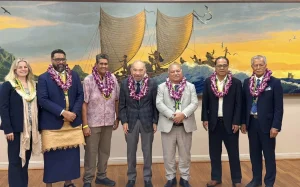
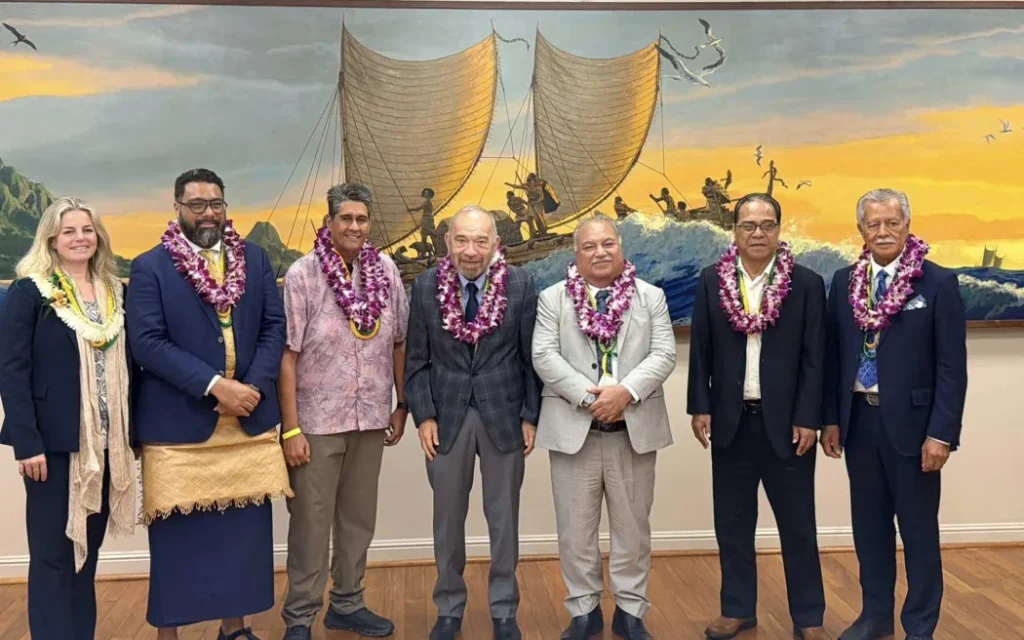
Honolulu became a quiet epicenter of Indo-Pacific diplomacy this week as leaders, ministers, and senior officials from 16 Pacific Island countries and territories gathered for The Pacific Agenda: Investment, Security, and Shared Prosperity Summit. Hosted at the East-West Center from February 22 to 24, the summit brought together Pacific governments, more than 80 major American companies, and key U.S. finance agencies in a coordinated effort to redefine economic and security cooperation across one of the world’s most strategically significant regions.
Co-hosted by U.S. Deputy Secretary Christopher Landau and Admiral Samuel J. Paparo, commander of the United States Indo-Pacific Command, the gathering reflected Washington’s sharpened focus on the Indo-Pacific. The conversations were not only about diplomacy, but about deployment — of capital, technology, infrastructure, and influence.
Across the three days, delegates examined partnerships spanning infrastructure development, critical minerals, supply chain resilience, energy security, tourism, food systems, digital economies, and financial services. American private-sector giants — including Google, Starlink, Matson, and The Wonderful Company — were among those participating, representing a combined market value exceeding $5.3 trillion. Their presence underscored a core theme of the summit: private-sector-led growth as the engine of regional prosperity.
Yet the discussions were grounded in tangible outcomes. At the closing session, several U.S.-funded initiatives were announced, many supported by the U.S. Trade and Development Agency (USTDA), signaling a shift from dialogue to delivery.
In Palau, a $2.37 million feasibility study will pave the way for relocating and redeveloping the Belau National Hospital, the country’s only hospital. The envisioned modern facility, with capacity for up to 150 beds, would expand advanced medical capabilities and facilitate the deployment of U.S. equipment previously unavailable to the island nation. In a region where healthcare access can be shaped by geography and vulnerability, such an investment carries both developmental and symbolic weight.
Digital transformation also emerged as a central pillar of cooperation. USTDA announced funding for two reverse trade missions that will bring senior officials from Pacific nations — including Fiji, Papua New Guinea, Samoa, Tonga, Tuvalu, and others — to the United States. The objective is practical: evaluate trusted technology solutions, identify financing pathways, and accelerate priority digital infrastructure projects. For many Pacific Island states, secure and reliable digital networks are no longer optional; they are foundational to economic diversification and governance.
Transportation and logistics infrastructure received parallel attention. Project scoping support will initiate processes to strengthen airport security in Kiribati, improve Tonga’s fuel supply reliability, upgrade Amata Kabua International Airport in the Republic of the Marshall Islands, redevelop Fiji’s historic Port of Levuka, and enhance mail delivery systems through commercial drone deployment. These may appear as discrete projects, but collectively they point to a broader strategy of reinforcing connectivity — by air, sea, and digital corridor.
Perhaps most consequential for long-term regional integration is the expansion of the Pacific Connect undersea cable network. The Republic of the Marshall Islands and American Samoa are set to join the system, backed by $132 million in U.S. government funding and an additional $3.4 million feasibility study. In an era where undersea cables form the backbone of global communications, digital inclusion has become inseparable from national security and economic sovereignty.
Security cooperation was also woven into the summit’s outcomes. The Indo-Pacific Command announced $3 million in funding to strengthen prosecutorial collaboration in the Freely Associated States. Leveraging a U.S. Department of Justice prosecutor based in Honolulu, the initiative aims to enhance capacity in addressing transnational criminal cases — an acknowledgment that economic growth and security stability must advance together.
Taken together, the Honolulu summit illustrates an evolving approach to Pacific engagement. It blends commercial diplomacy with strategic reassurance, private investment with public financing, and infrastructure with institutional strengthening. As geopolitical competition intensifies across the Indo-Pacific, the Pacific Island nations find themselves at the center of renewed global attention.
For the island states, the significance lies not only in the scale of commitments but in the alignment of development priorities — healthcare modernization, digital connectivity, transport infrastructure, and institutional capacity. For the United States, the summit signals a deliberate effort to position itself as a long-term economic and security partner in a region that is increasingly central to global trade, technology flows, and maritime stability.
In Honolulu this week, diplomacy was measured less in speeches and more in feasibility studies, funding commitments, and infrastructure blueprints — practical instruments of what policymakers describe as shared prosperity.