Just five years remain before the 2030 Agenda for Sustainable Development deadline, which the world set to make equality a reality for all. Yet global poverty retains a female face. Countries worldwide have ratified conventions and declarations promising inclusion, but ten percent of women still live in extreme poverty, a number that has barely shifted since pandemic 2020. In 2024, women were more likely than men to go hungry, with 26.1 percent facing food insecurity compared to 24.2 percent of men, which translates to 64 million more women than men. Ongoing conflict, weak political will, harmful stereotypes, and exclusion from key decision-making spaces continue to enforce the gap.
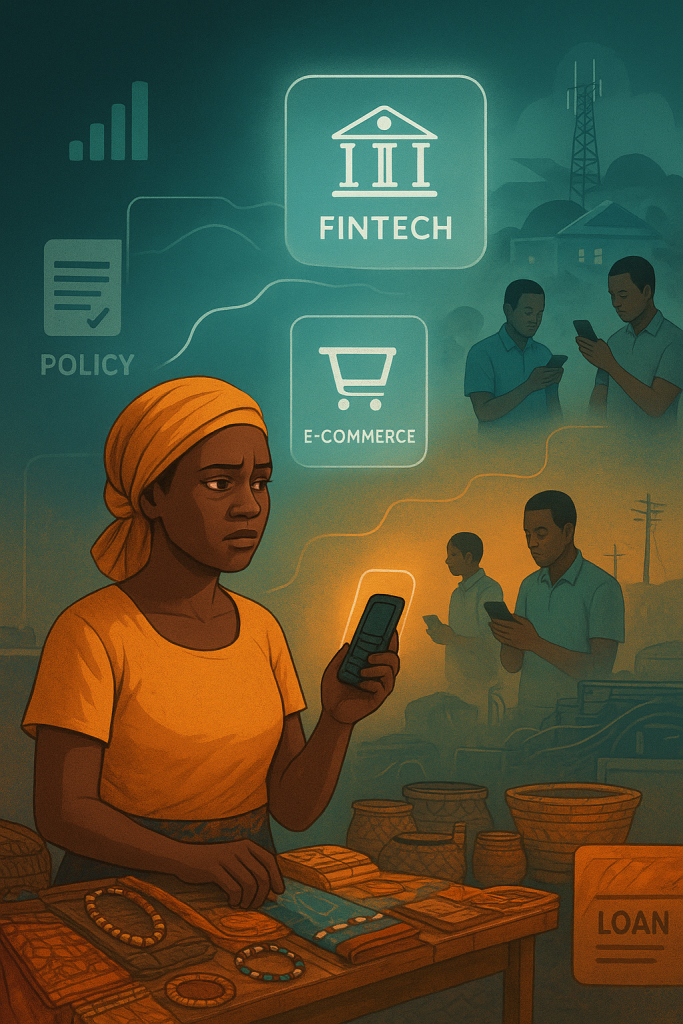
Across the world, economies are moving rapidly online, with trade, finance, and services increasingly conducted through digital platforms. Africa today is undergoing a similar transformation, though with uneven access and infrastructure. Mobile money, fintech apps, and e-commerce marketplaces are no longer conveniences; they are becoming the backbone of economic activity, from small village traders to larger Small and Medium-sized Enterprises (SMEs). Across cities and towns, smartphones are the new tools of commerce, education, and civic participation. Yet this digital shift is uneven: men are far more likely than women to own a smartphone, have reliable internet access, or participate in digital marketplaces. As the continent’s economy moves online, many women risk being left behind, further excluded from growth, markets, and the benefits of a connected future.
Across the continent, women account for the majority of informal cross-border traders, yet they remain largely invisible in policy and regulatory frameworks. International commitments exist to address this: the Buenos Aires Declaration on Women’s Economic Empowerment, Convention on the Elimination of All Forms of Discrimination against Women (CEDAW), and the African Continental Free Trade Area (AfCFTA) Protocol on Women and Youth in Trade promise better access, reduced barriers, and financial inclusion. Regional instruments such as the East African Community’s Simplified Trade Regime and the Southern African Development Community’s (SADC) Protocol on Gender and Development reinforce these norms. Yet despite these frameworks, implementation is uneven, leaving many women at the margins of economic society.
From my perspective as a development worker, I have seen some of these barriers firsthand, and heard many similar stories from women across Nigeria. Women often have the interest and drive to sell online and across countries, but struggle with packaging and quality requirements, insufficient access to credit, insecurity, network interruptions, devices that can’t run apps, or phones shared among family members. Small fintechs such as Moniepoint, OPay, Kuda, and PalmPay have opened new doors, offering easier payments, credit, and mobile wallets, yet many women hesitate to engage fully due to fear of aggressive loan collection messages, app notifications threatening repayment, or fraud.
Digital access alone, however, does not guarantee participation. Interruptions in network service and weak internet infrastructure hold back young entrepreneurs and women alike, even when devices are available. Connectivity problems can disrupt transactions, block access to learning resources, or prevent timely market responses. Combined with online harassment, threatening messages, and unsafe digital spaces, the risks of exclusion are not only economic but also social.
Leadership gaps further compound the problem. Rwanda, on the one hand, leads the world with roughly 64 percent women in parliament, while Nigeria struggles to retain only about 3-5 percent. This imbalance affects who designs policies, who prioritizes funding, and whose voices are included in trade, digital finance, and procurement systems. When women are underrepresented in leadership, programs meant to support women often fail to address the real constraints they face.
This lack of representation also influences who benefits from public spending and procurement opportunities. Global public procurement is estimated at $13 trillion annually. In Nigeria, only about 1 percent of contracts go to women-owned businesses. Many women-led micro and small enterprises cannot navigate tender requirements, lack formal documentation, or are excluded because they cannot compete with better-connected male counterparts. Domestic policies like the Nigeria First Policy and related executive orders aim to prioritize local businesses, but women-owned enterprises often remain sidelined, missing opportunities for scale and stability.
Making digital and economic inclusion work requires attention to everyday realities. Solutions need to be multifaceted and multisectoral, addressing affordability, access, safety, and trust together. Subsidized data plans, low-cost devices, fintech apps designed for ease-of-use, and training programs can help bridge the gap. For procurement or formal trade, simpler tender processes, gender quotas, and capacity-building support are essential. These measures must consider unpaid care work, mobility constraints, and limited formal education for many women entrepreneurs.
The 16 Days of Activism Against Gender-Based Violence and this year’s theme, “UNiTE to End Digital Violence Against All Women and Girls” remind us that inclusion is not just about devices or finance. Online harassment, threatening loan messages, and unsafe digital platforms can push women out of marketplaces entirely. Digital safeguarding must be part of every inclusion strategy, from fintech apps to e-commerce platforms and public procurement portals. Digital violence is not just a safety concern; it is a form of economic violence that undermines women’s livelihoods. Women must be able to participate safely, securely, and confidently.
The economic case for inclusion is strong. Studies by the McKinsey Global Institute (MGI) and other organizations highlight that achieving gender parity could add between $12 trillion and $28 trillion to the annual global GDP. When women can trade online, locally, and across borders safely, access financial tools, learn, work, and participate in leadership, businesses scale, households prosper, and national economies grow. Digital and economic inclusion is not just fairness; it is smarter development and stronger growth. Africa’s digital future will be richer and more resilient only if women are at its center.