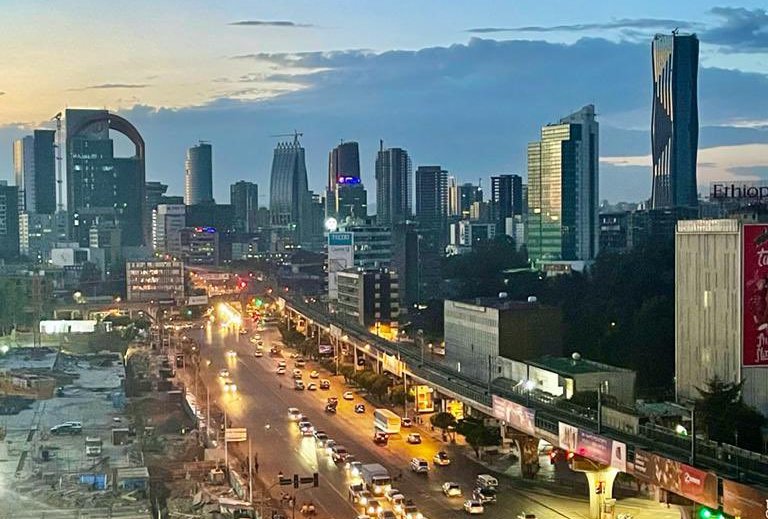
Addis Ababa, Africa’s unofficial capital, presents an elegant and demure outlook. Perhaps no corporate establishment embodies the ideals of the African Union, headquartered in Ethiopia, more than The Ethiopian, which prides itself on “The New Spirit of Africa.”
Sitting in the ultra-modern airbus bound for Addis from the Washington Dulles International Airport, by my side was a Congolese man, behind me was a Kenyan lady of Kikuyu extraction, and next was a Cameroonian. There was also a generous number of Ethiopians and, of course, a handful of other nationals from across the globe. All were Addis bound for their connecting flights to various other aviation hubs or travel destinations in Africa.
Upon touchdown, I refreshed myself in the shimmering lounge of the Addis Ababa International Airport, sipping hot “Bunna,” the Ethiopian coffee. As savoring its rich and deep taste, my thoughts glided across the Abyssinian land: a modest country at the horn of Africa that has played noble roles in both history and religion.
The land, we all know, boasts of a huge number of Judaeo-Christian heritage sights, including the possibility of the Ark of Covenant being sheltered in an ancient stone church in Aksum. We also know about the Biblical Queen of Sheba, whose historic visit to the Hebrew King Solomon has spun great stories of romance. Ethiopia, of course, was home to the Ethiopian Eunuch, the baptism of whom was one of the landmark events in the New Testament of the Bible.
We say in the marketing world, “If you’ve got it flaunt it.” The Ethiopian Airline is today the PR tool for Ethiopia. Harnessing the beauty of its people and the splendor of its landscape, it uses inflight media to spotlight its tourism endowments, scenic landscapes, attractive parks, and a generous array of religious sights. You could not but look forward to relishing a land brimming with nature’s beauty and archaeology.
As with all major airlines, most of its flights’ transit through its home airport – the Bole International Airport, one of the best in Africa. To further consolidate its aviation gains, the Prime Minister recently announced a soon-to-be-commenced visa-on-arrival for all Africans visiting or transiting from Addis Ababa. The country has also embarked on an ambitious expansion of the airport to cope with its ever-expanding passenger traffic.
As the plane taxies off, the flier is greeted by the blooming expanse of the Great Rift Valley as well as its spread-eagled highlands and savannah vegetation. You are bade farewell by a landscape generously endowed with a rich fauna of wildlife most of which are endemic to Ethiopia.
It is exciting to see a nation working hard to rebuild from the ashes of drought and destructive wars over the years. The Ethiopian recently made its first flight to Asmara, the capital of Eritrea, sealing a peace deal negotiated between the leaders of both countries ending a border dispute that had dragged on for many years leaving blood on its trails. This stroke of deal ushered in a floodgate of investment, tourism, and economic opportunities for both countries.
As the aircraft settled in the air, I made to start a conversation with a middle-aged man sitting by me completely plugged into the multi-media. “Sorry,” he said to me, “I am not very good at English.” “What do you speak, then?” I inquired, “Amharic, I speak Amharic,” he replied. Well, I paddled my own canoe and settled myself on documentaries and movies.
Amharic I got to understand is the national language of Ethiopia. As the pretty Ethiopian air hostesses made their service runs across the aisle in the fuselage, they spoke to those they sensed were Ethiopians in Amharic and to the rest of us in English. Amharic is also the language of teaching and learning in Ethiopia, with English on the side-lines. That is huge, I thought to myself. The early ruling class of Ethiopia, though a minority tribe, was mainly Amharic. That way the language found its way to become the unifying tongue of Ethiopians.
It is heartening to witness the airline continue on its track of aviation proficiency after the painful incident of the ill-fated Boeing 737 Max mishap of March 2019, arising from factory errors, rather than the airline’s internal capacity.
Ethiopia’s path to aviation glory is a story of how we could make lemonades with the lemon that life throws at us. Not long ago, the Ethiopian transport system was chiefly made of mules, horses, and Caramels. It’s rugged terrain and difficult landscape made road and rail transportation infrastructure expensive. The people chose rather to invest in aviation. From excelling in domestic operations, Ethiopian Airlines, like the Eaglet grew stronger wings to take on the blue skies and today has become the aviation powerhouse of Africa.
Boasting a fleet of over 120 aircraft, and more than 120 international destinations, three of which are in Nigeria, (Abuja, Lagos, and Enugu until Enugu was closed) The Ethiopian traverses Europe, the United States, Asia, and the Middle East. In 2009 alone it made a revenue of over $1.16 billion (nearly 417 billion Nigerian naira) – a significant contribution to Ethiopia’s foreign exchange earnings. With a staff strength of over 5000 personnel and trainees numbering over 6500 in its aviation academy, the Airline is a major employer of labor and a major contributor to the Ethiopian GDP.
In 2015, Ethiopia was declared the world’s best tourist destination by the European Council on Tourism and Trade. With an economy chiefly made of coffee, gold, hides, and skin, Ethiopia is poised to reposition itself to harness its tourism potential in its rebuilding process. This is not altogether surprising considering the reach of its aviation network and efforts by the government to invest in peace-building both amongst Ethiopians and its neighbors, especially Eritrea.