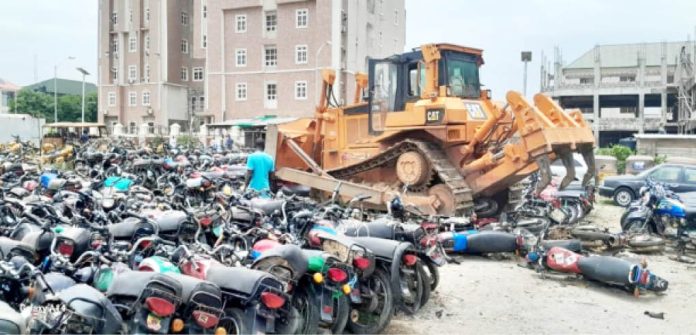
In a decisive move reflecting a broader trend among global megacities to reclaim public order and reduce urban crime, authorities in Nigeria’s Federal Capital Territory (FCT) have crushed 601 commercial motorcycles (popularly known as okadas) for violating city-wide operational restrictions.
The exercise, carried out under the supervision of Dr. Chinedum Elechi, Mandate Secretary of the FCTA Transportation Secretariat, is part of a sweeping enforcement campaign aimed at sanitizing Abuja and reinforcing the rule of law in high-risk zones.
“This is not a random action,” said Dr. Elechi. “It is backed by regulation—specifically the law signed on January 1, 2023, under the administration of former FCT Minister Mohammed Bello. Operating motorcycles in over 45 restricted areas in Abuja is illegal, and our enforcement reflects that.”
For decades, commercial motorcycles have provided low-cost, flexible transportation across many African cities. However, they have also been linked to rising rates of urban crime, traffic disobedience, and accidents. In Abuja, a city designed with modern urban planning ideals, the use of motorcycles in central districts has been a subject of controversy.
Dr. Abdulateef Bello, Director of the Directorate of Road Traffic Services (DRTS), explained that the 2025 enforcement marks the first mass crushing of the year. “The ban, initially introduced in 2006, was intended to control traffic violations. But today, it has become a matter of public safety, as motorcycles have increasingly been used to facilitate crimes,” he noted.
Law enforcement officials are strongly backing the operation. Assistant Commissioner of Police (Operations), AC Mode Magawata, stated that the clampdown has helped stem the tide of criminal activities in Abuja. “Some operators use these motorcycles for theft, surveillance, or quick getaways. Continued enforcement is yielding results and ensuring a safer city,” he said.
Balancing Security and Livelihoods
While the FCTA insists the operation is necessary, the move raises significant questions about economic displacement and access to affordable transport. Commercial motorcycles have long served as a livelihood for thousands of youth in Nigeria, many of whom lack access to formal employment opportunities.
Globally, cities such as Jakarta, Kampala, and Nairobi have faced similar dilemmas. Efforts to restrict or regulate motorcycle taxis in urban centers often collide with the socio-economic reality of informal labor markets. The challenge remains: how can governments uphold urban safety and structure without disproportionately affecting the urban poor?
Dr. Elechi addressed these concerns, noting that the FCTA is not simply penalizing offenders, but working to uphold a standard of order. “Investors and riders should take note—this business model is no longer sustainable in restricted zones. We are urging the public to transition to legal, structured forms of urban mobility,” he said.
As Abuja aligns with the practices of cities striving to enforce smart mobility policies and curb insecurity, the case reflects a growing regional conversation: how African capitals can develop without leaving millions behind. With urban populations set to double in many parts of Africa by 2050, cities like Abuja are at the crossroads of policy, security, and socio-economic survival.