Editor’s Note:
As Africa’s urban centers increasingly capture global attention for their dynamic growth and challenges, Etamagazine remains committed to spotlighting transformative leadership and development stories across the continent. In this report, we take a closer look at how the Federal Capital Territory of Nigeria is navigating infrastructure expansion, governance reforms, and urban planning under the stewardship of Honourable Minister Barr. Ezenwo Nyesom Wike. Abuja’s evolving narrative offers insights not just for Africa, but for cities worldwide aspiring towards sustainable and inclusive growth.
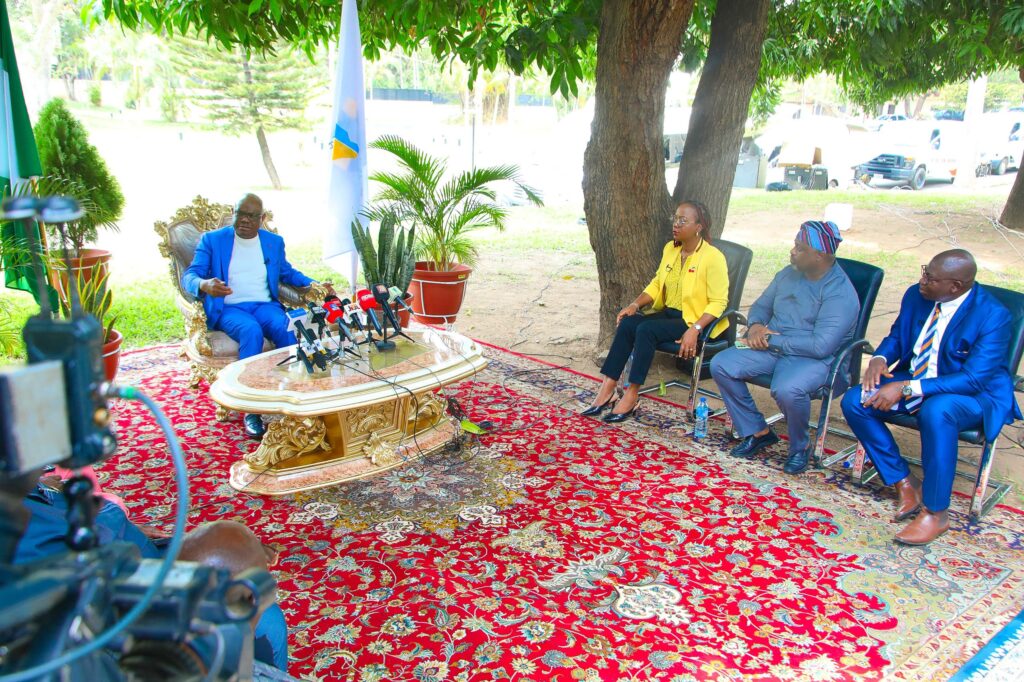
In a move that underscores a renewed push for sustainable development in Africa’s leading capital cities, the Honourable Minister of the Federal Capital Territory (FCT), Barr. Ezenwo Nyesom Wike, on Friday, April 18, 2025, addressed critical development issues during a media parley in Abuja. Speaking from his official residence in Life Camp, the Minister detailed an ambitious roadmap for healthcare, land management, urban sanitation, transportation infrastructure, and political accountability.
Highlighting Abuja’s accelerated pace of development, Minister Wike emphasized the tangible improvements felt across the territory.
“The difference is clear,” he stated. “Residents are amazed at what we have achieved in less than two years. If we have done this much already, imagine the transformation that four years will bring.”
The Minister cited examples from rural communities such as Kwali and Bwari, where long-neglected roads like the A2 to Pai and the Gaba/Tokulo route are now receiving unprecedented attention. “For the first time, rural dwellers feel seen and included,” he noted.
On the highly scrutinized renovation of the iconic International Conference Centre (ICC), Wike defended the project’s cost, explaining that the quality of work being delivered by renowned construction firm Julius Berger Plc justifies the investment.
“By May, Nigerians will be proud of the new ICC,” he assured, inviting the public to witness the transformation firsthand.
The Minister also addressed healthcare development, recognizing the complex challenges involved in hospital construction in Utako, Gwagwalada, and Kubwa, particularly where litigation has delayed progress. Nonetheless, he reaffirmed the administration’s commitment to completing the facilities to strengthen the healthcare system within the FCT.
In a bid to modernize land management, Wike reiterated that, following a Supreme Court ruling, all lands within the FCT fall under the authority of the Federal Capital Territory Administration (FCTA).
“There is no such thing as Area Council land,” he stressed. “We are regularizing allocations to ensure landowners can obtain proper Certificates of Occupancy (C of O), encouraging development and curbing land speculation.”
He further warned that failure to fulfill financial obligations, particularly among land allottees, would lead to forfeiture of rights, signaling a tougher stance on underutilized lands in key districts such as Maitama II.
Reaffirming his administration’s dedication to preserving Abuja’s original vision, Wike called for patience regarding the ongoing review of the Abuja Masterplan.
“We are not changing Abuja’s dream,” he said. “We are protecting it.”
He cited active efforts to demolish illegal developments, referencing current enforcement activities in Kpaduma, Asokoro.
Turning to sanitation, the Minister emphasized the financial burden of waste management on the government and appealed for increased civic responsibility.
“Residents must begin to pay their sanitation fees. Clean cities require collective effort,” he urged, calling on the media to support public education campaigns around taxation and sanitation compliance.
On transportation, Wike disclosed that three major bus terminals would soon be operational, a development expected to drastically reduce illegal motor parks and improve traffic management.
“We will designate loading and dropping points to restore order on our roads,” he explained.
In a moment of political candor, the Minister critiqued the internal struggles plaguing the Peoples Democratic Party (PDP), questioning its preparedness for the 2027 elections. He argued that genuine sacrifice and leadership are necessary to revitalize opposition politics in Nigeria.
“The Governors Forum is merely a pressure group; it cannot substitute for real party leadership,” he asserted.
Wike warned that if internal conflicts persist, he might withdraw his support for the PDP in the upcoming Area Council elections, signaling a critical turning point for the party’s local political prospects in the FCT.
Addressing the crisis in his home state of Rivers, Wike backed President Bola Ahmed Tinubu’s emergency interventions, crediting them with averting anarchy and restoring functionality to local governance structures.
He called on Rivers’ elders and political leaders to embrace true reconciliation efforts rather than empty rhetoric.
As Abuja positions itself to join the ranks of globally admired cities, Minister Wike’s blueprint signals a critical moment in Africa’s ongoing urban evolution — one that will require strategic vision, strong institutions, and sustained public engagement to achieve its full potential.